Road to Access resources
ICPR 2026 conference talk

Are reimbursement pathways ready for licensed psychedelic therapies in Europe?

A conference talk on the four gates between European approval and real patient access: assessment, payment, delivery, and the national implementation work needed before psychedelic therapies can reach patients.

Watch the ICPR 2026 talk

Road to AccessBlossom's implementation and access hubEurope Access ClocksApproval-to-access timingReimbursement reportFull report

Conference talk

Are reimbursement pathways ready for licensed psychedelic therapies in Europe?
Slide 01
Title slide for the ICPR 2026 reimbursement and access talk.

Slide transcript

This talk asks a practical question: are European reimbursement pathways ready for licensed psychedelic therapies?

I am Floris Wolswijk, founder of Blossom, a consultant with Delphi, and a volunteer with the OPEN Foundation. The talk sits inside Blossom's broader Road to Access work on how promising treatments actually reach patients.
Related Blossom resources

ICPR 2026

Conflict of interest disclosures

Slide 02
Conflict of interest disclosure slide.

Slide transcript

For transparency: I founded and own Blossom, and I also co-founded FLO Coaching, which offers legal psilocybin coaching in the Netherlands.

I am part of the core team at Delphi, where I advise organisations across the psychedelic field. I did not receive an honorarium for this talk.

The reimbursement report behind the talk was funded by Norrsken Mind and co-authored with Martin Gisby from Magnetar Access. I have also volunteered with the OPEN Foundation, the organiser of ICPR, since 2020.

Part one · The patient

Meet Marieke

Slide 03
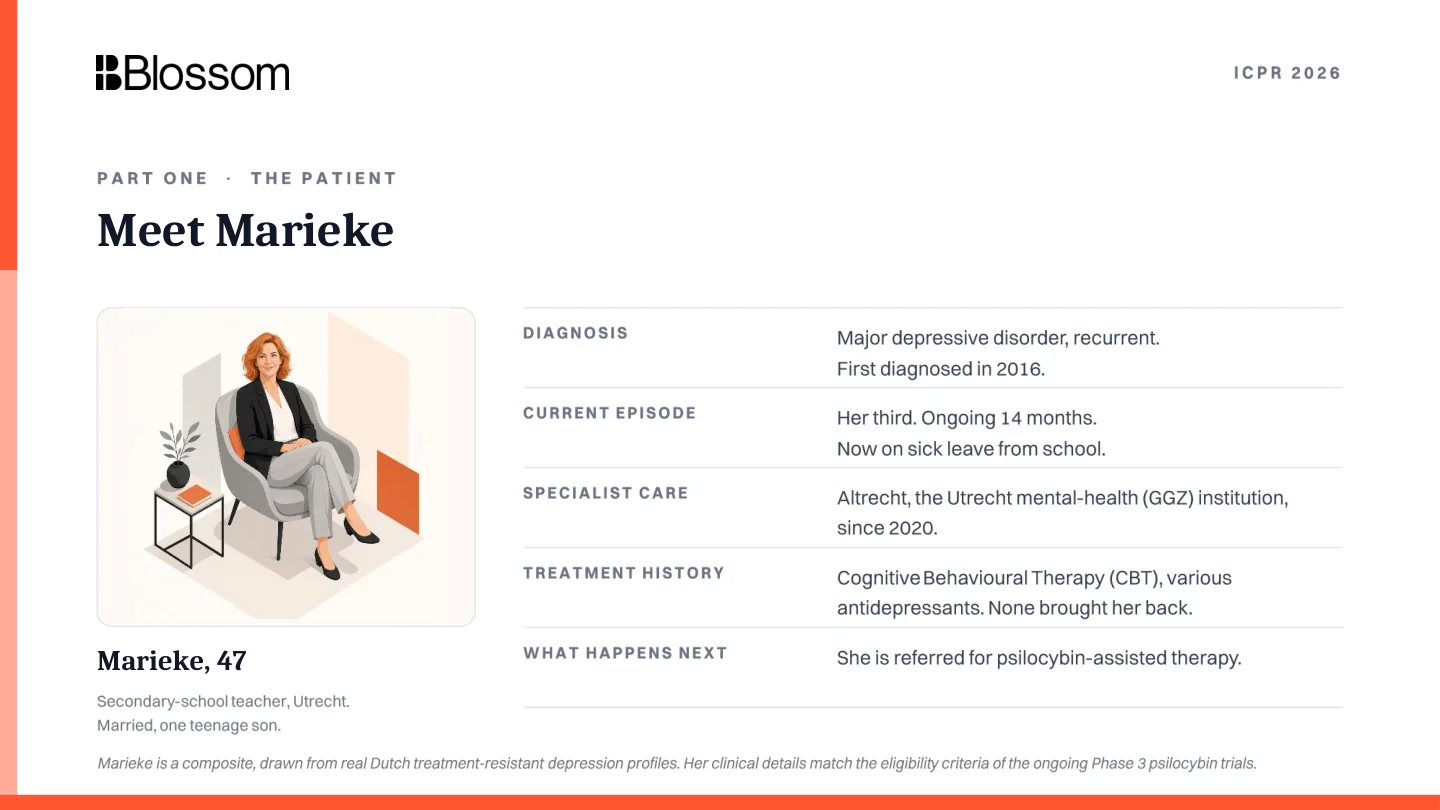
Composite patient profile for Marieke.

Slide transcript

Meet Marieke. She is a 47-year-old secondary-school teacher in Utrecht, married, with one teenage son.

She has recurrent major depressive disorder. This is her third episode, it has lasted 14 months, and she is now on sick leave from school. She has been in specialist GGZ care since 2020 and has tried CBT and multiple antidepressants without getting back to herself.

For the talk, Marieke is a composite patient. Her profile matches the kind of treatment-resistant depression population now being studied in late-stage psilocybin clinical trials. The point is to keep the access pathway grounded in a person, not only in regulatory diagrams.

Related Blossom resources

Part two · The Road to Access

Approval is not access

Slide 04
Four access gates between European licensing and treatment.

Slide transcript

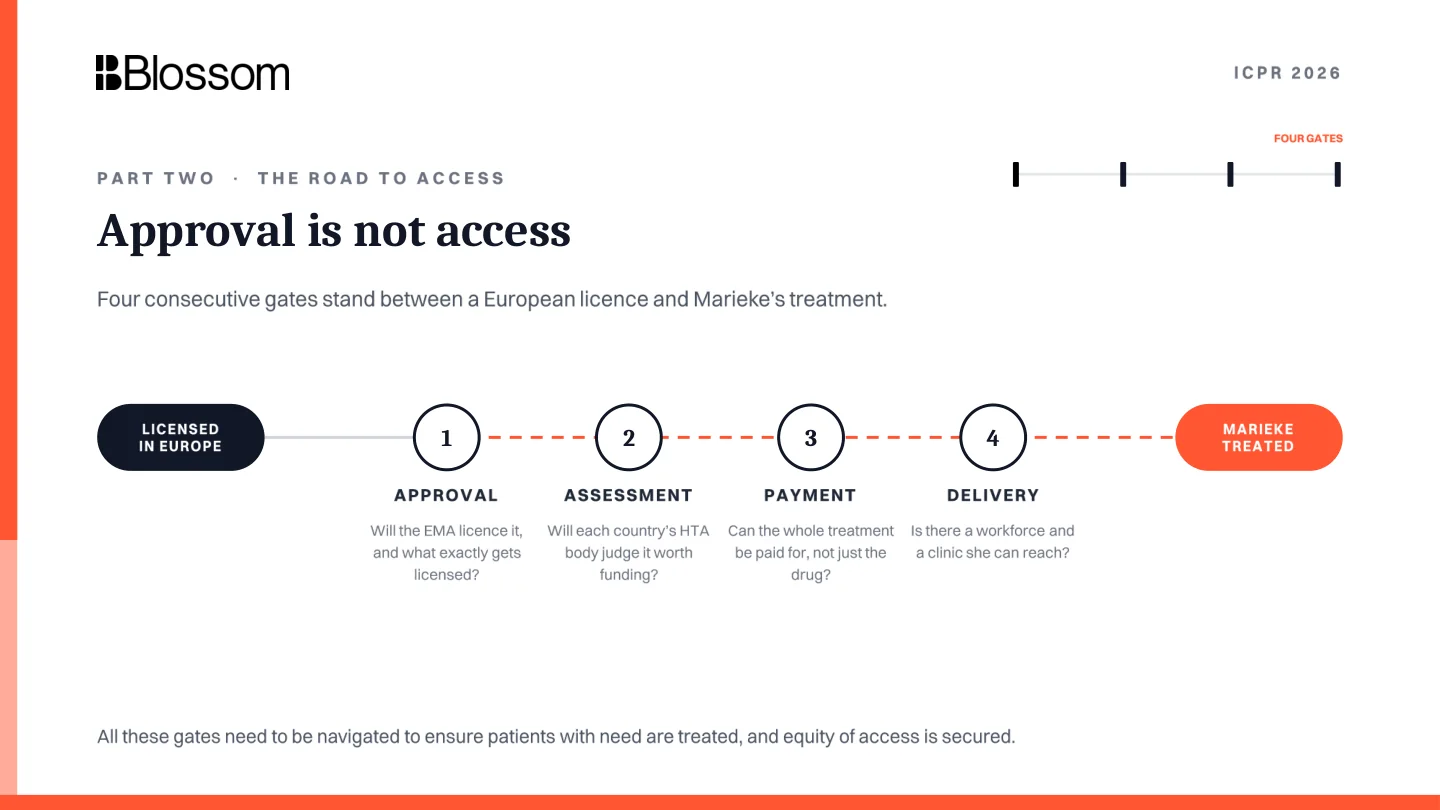
Approval is not the same thing as access. A European licence is only the first gate in the Road to Access.

Marieke still has to pass through national assessment, payment, and delivery. The HTA body has to judge the treatment worth funding, the system has to pay for the whole care episode, and a real clinic with trained staff has to be available.

If any one of those gates fails, the treatment can be approved on paper while remaining unavailable to the people who need it.

Related Blossom resources

Gate one · Approval

The trial-to-licence gap

Slide 05
Comparison of what Phase 3 tests and what the EMA licenses.

Slide transcript

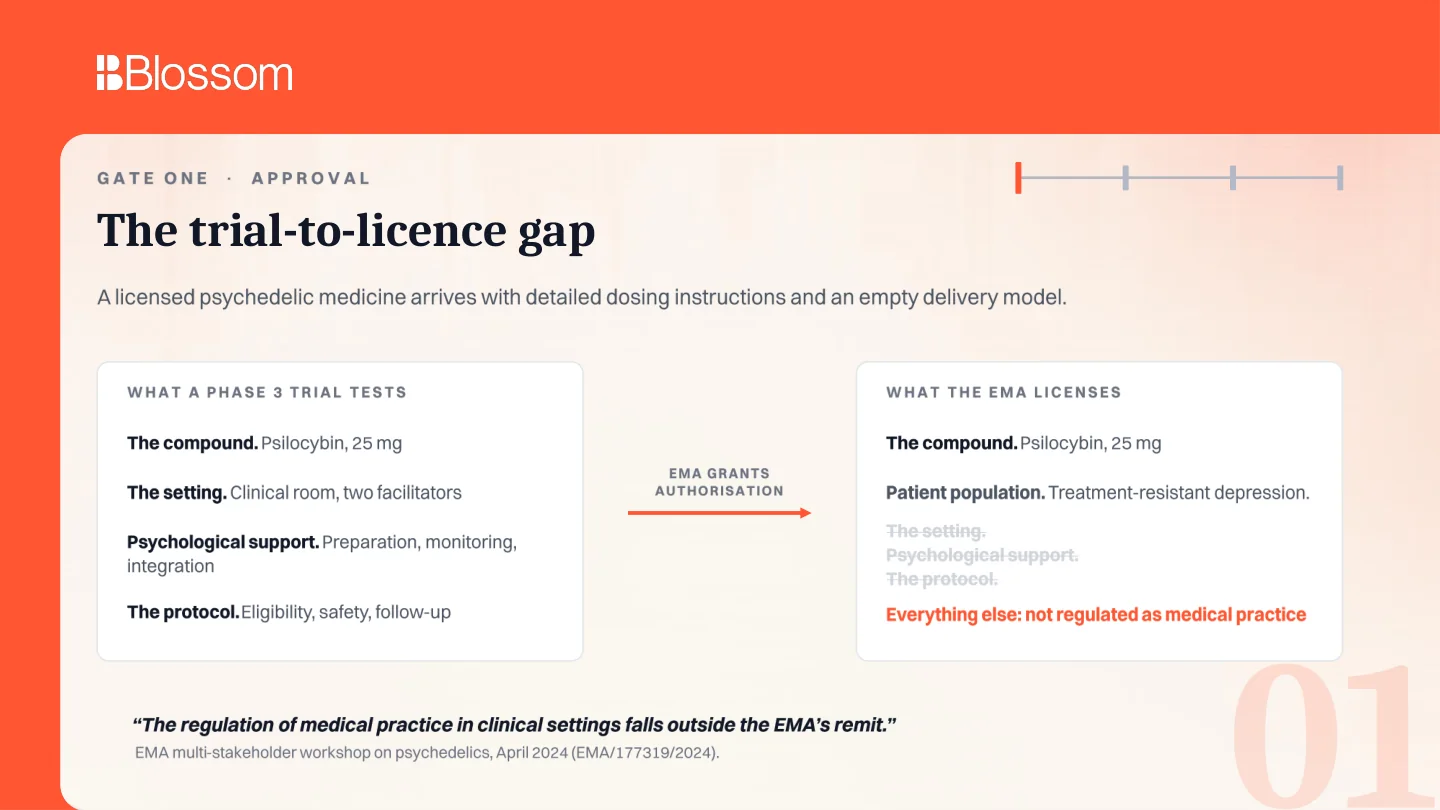
A phase 3 trial tests much more than the molecule. It tests a dose, a room, facilitators, psychological support, eligibility rules, safety procedures, and follow-up.

The EMA, however, mainly licenses the medicine and its patient population. The surrounding care model stays in the domain of medical practice, which is why the clinical delivery model cannot be treated as a detail to solve later.

That creates a trial-to-licence gap: the approved product can arrive with detailed dosing instructions but without a settled delivery system.

Related Blossom resources

Gate one · Approval

Four problems in the trial, four in the appraisal

Slide 06
Methodological trial problems and downstream appraisal problems.

Slide transcript

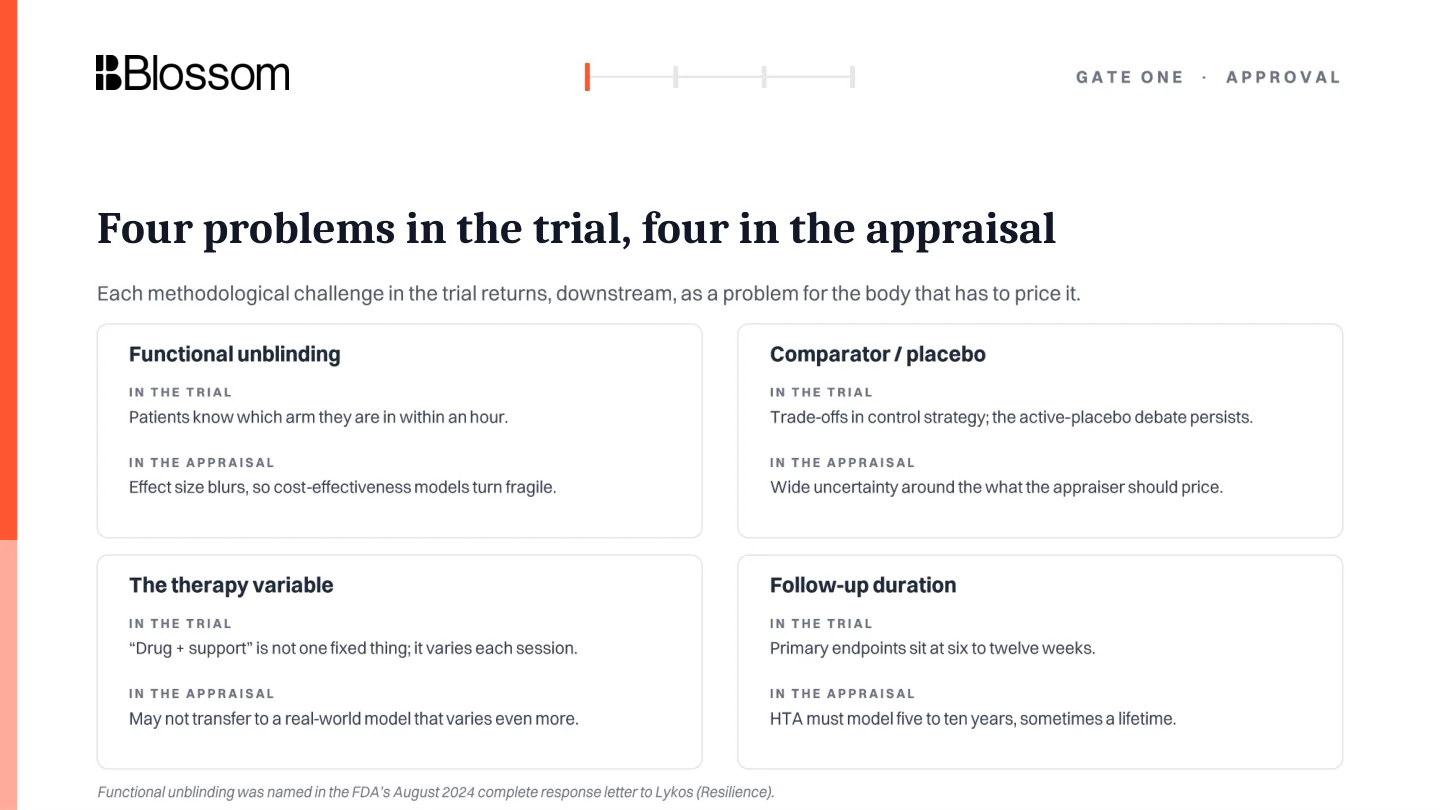
The methodological problems in a psychedelic trial do not disappear at approval. They come back as HTA uncertainties for the body that has to decide what the treatment is worth.

Functional unblinding can blur the effect size. Comparator choices shape what the payer thinks it is pricing. The therapy component varies across sessions and may vary even more in routine care.

The time horizon is another major mismatch. Trials often measure outcomes at 6 or 12 weeks, while HTA models may need to estimate 5 years, 10 years, or even a lifetime. That is why the trial follow-up versus HTA horizon question matters so much.

Related Blossom resources

Gate one · Approval

Who reaches Marieke first

Slide 07
Late-stage depression programmes and estimated EMA timing.

Slide transcript

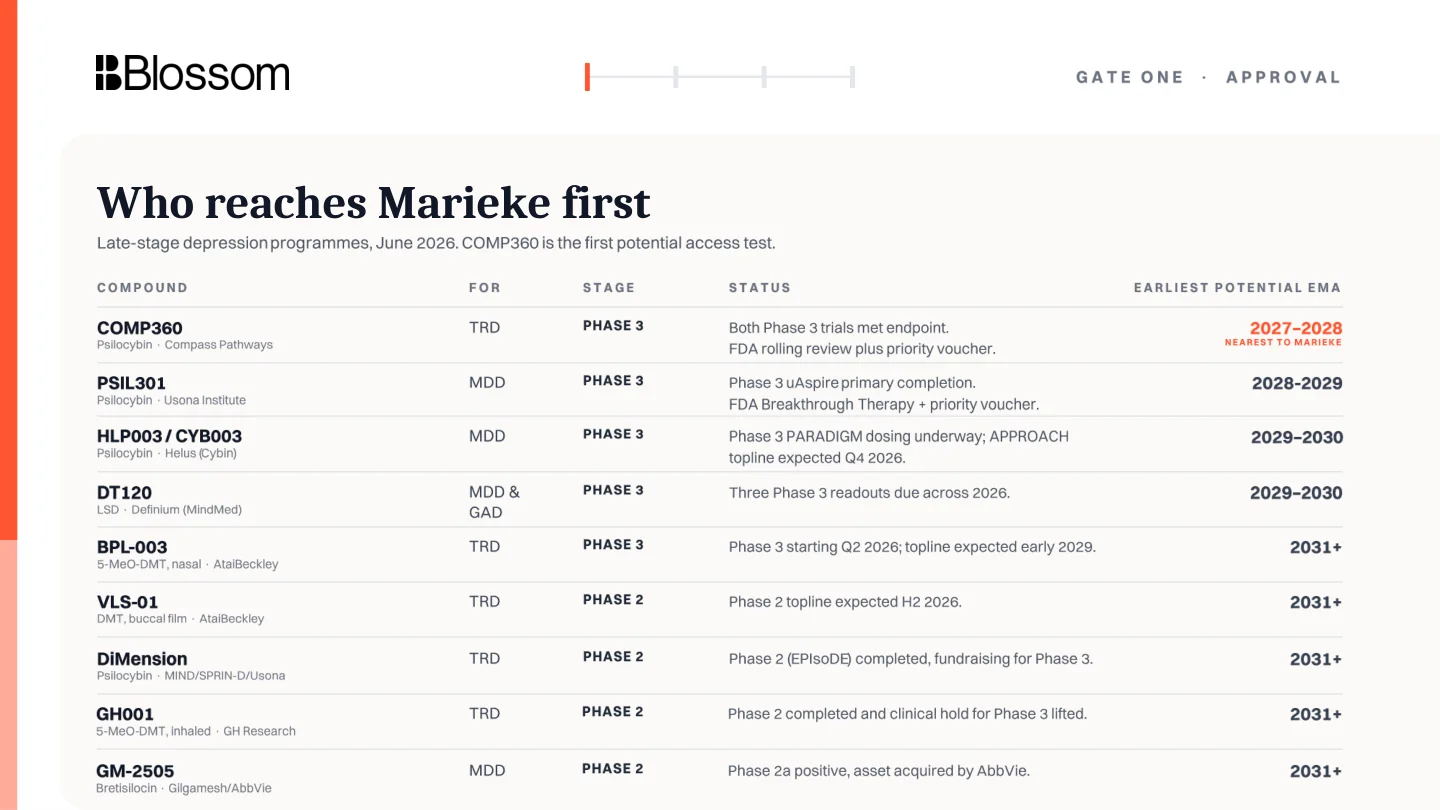
Looking at the late-stage depression pipeline, COMPASS Pathways and COMP360 are the first likely test case for European access. If timelines hold, a possible EMA window sits around 2027 to 2028.

Other programmes from Usona Institute, atai/Beckley, Cybin, MIND, GH Research, and others may follow, but most are later or less certain. The sequencing matters because the first product will set expectations for the next ones.

The practical question is not only who reaches approval first. It is who creates the first real access test across assessment, payment, and delivery. Blossom's clinical trials database is the place to follow that pipeline as it changes.

Related Blossom resources

Gate one · Approval

Four countries, four access clocks

Slide 08
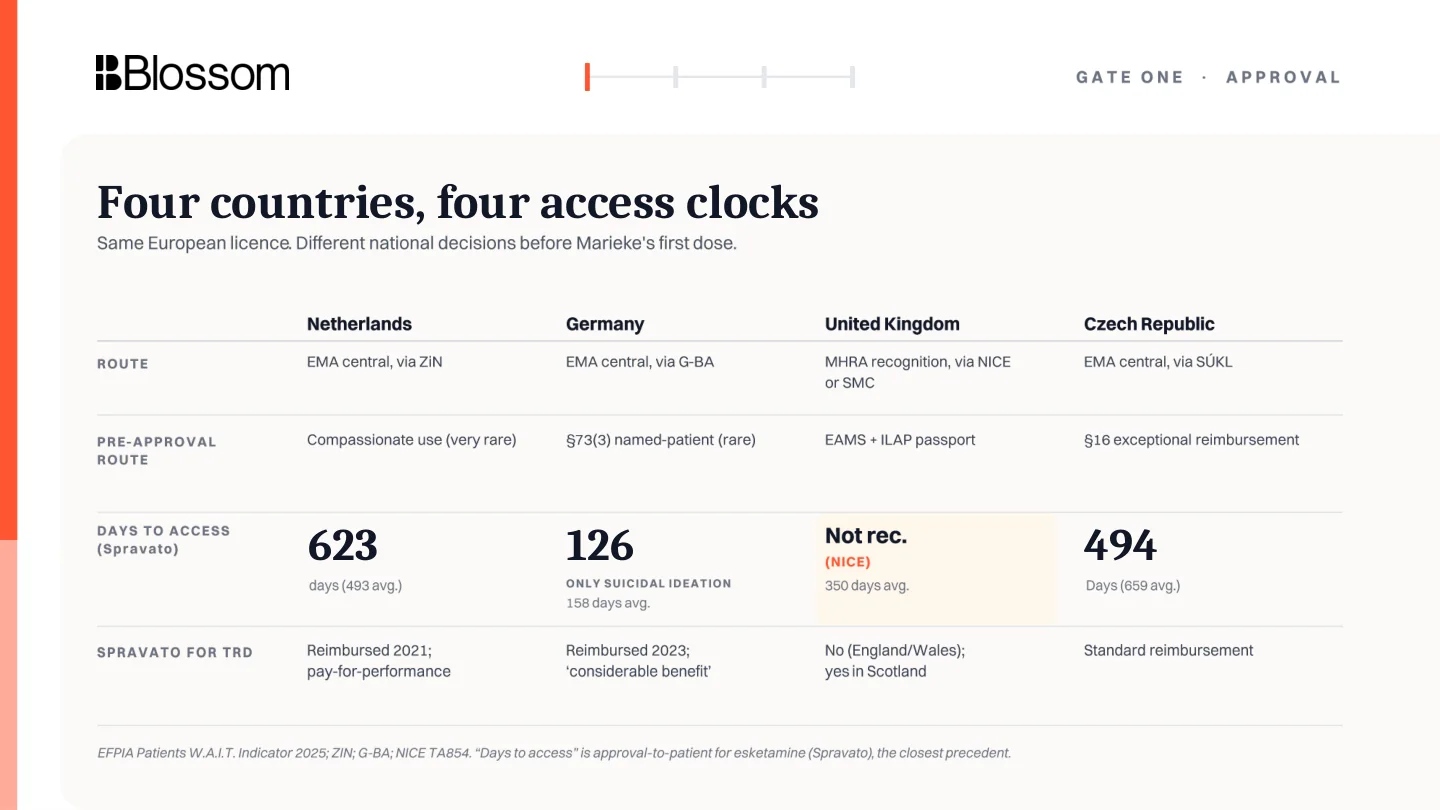
Comparison of approval routes and access clocks across four countries.

Slide transcript

The same European licence can lead to very different national access clocks. The Netherlands, Germany, the United Kingdom, and Czech Republic each have their own route after central approval.

Spravato is the closest precedent here. It shows how approval-to-patient timing can diverge sharply by country, even when the medicine is the same. Blossom tracks that pattern in the Europe Access Clocks resource.

The message is simple: European approval starts the clock, but national reimbursement and delivery systems decide when a patient can actually be treated. The Spravato access precedent is a useful warning for psychedelic therapies.

Related Blossom resources

Gate two · Assessment

Marieke hits the wall

Slide 09
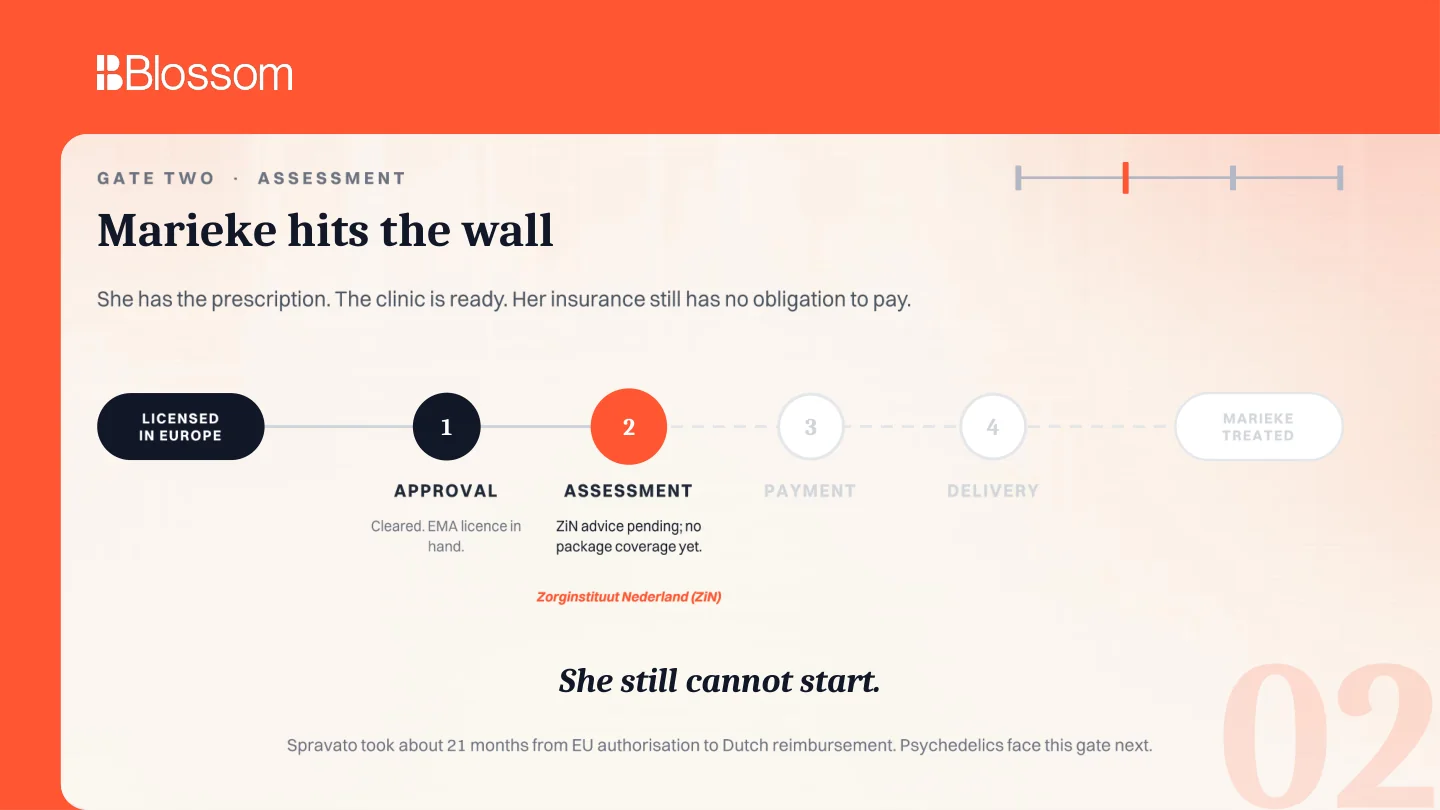
Assessment gate showing coverage pending after approval.

Slide transcript

Now imagine the product is approved and Marieke has a prescription. The clinic is ready, but her insurer still has no obligation to pay.

That is the assessment gate. In the Netherlands, Zorginstituut Nederland has to decide whether the treatment belongs in the basic package. The Netherlands HTA Access Clock explains why this step can take real time.

Spravato took about 21 months from EU authorisation to Dutch reimbursement. Psychedelic therapies face this same gate next, with even more uncertainty around the treatment model.

Related Blossom resources

Gate two · Assessment

Three uncertainties ZiN must resolve

Slide 10
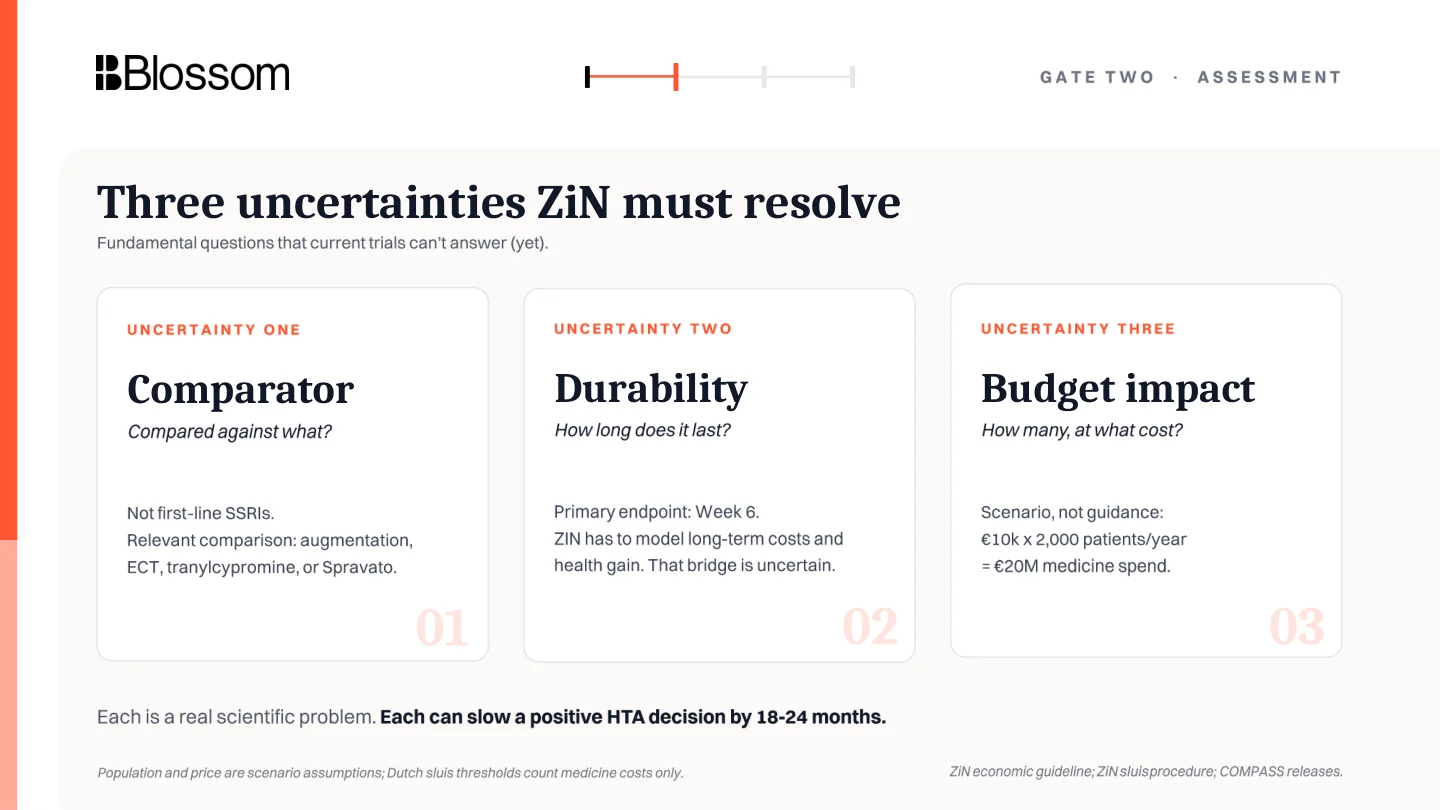
Three uncertainties for Dutch HTA: comparator, durability, and budget impact.

Slide transcript

ZiN will have to resolve 3 big uncertainties. None of them is obstruction; each is a real question the current trial data does not fully settle. I unpack them in Psilocybin HTA Uncertainties.

First: compared against what? Psilocybin will not be judged against first-line SSRIs. The relevant comparison is more likely augmentation, ECT, tranylcypromine, Spravato, or some combination of current specialist care.

Second: how long does the benefit last? A week-6 primary endpoint does not by itself tell an HTA body how to model long-term costs and health gain.

Third: how many patients, at what price? A simple scenario of EUR 10,000 times 2,000 patients per year already creates a EUR 20 million medicine-spend question, before the surrounding care costs are fully counted.

Related Blossom resources

Gate two · Assessment

Trials end. HTA decisions don’t.

Slide 11
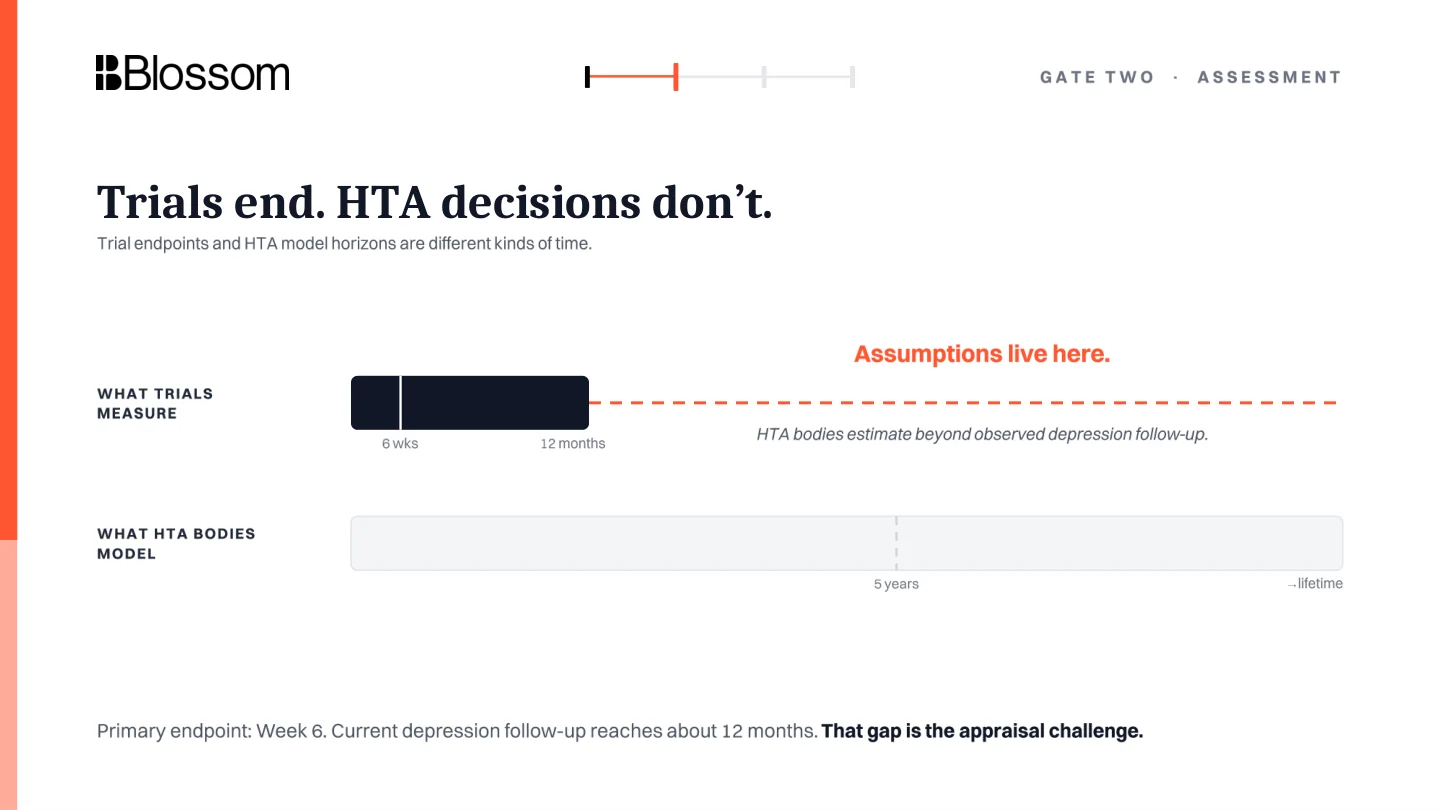
Timeline showing trial endpoints and HTA model horizons.

Slide transcript

Trials end, but HTA decisions do not. A trial might have a week-6 primary endpoint and perhaps 12 months of follow-up. An HTA model may need to estimate 5 years, 10 years, or a lifetime.

That gap is where assumptions live. It is also why post-launch evidence and registries are not optional extras. The trial follow-up versus HTA horizon resource breaks down this mismatch.

For psychedelic therapies, the follow-up question is tied to relapse, retreatment, durability, and how much of the care pathway continues after the dosing day. That makes real-world evidence design part of the reimbursement strategy.

Related Blossom resources

Gate two · Assessment

Four countries, four HTA postures

Slide 12
Four-country comparison of HTA postures and value frameworks.

Slide transcript

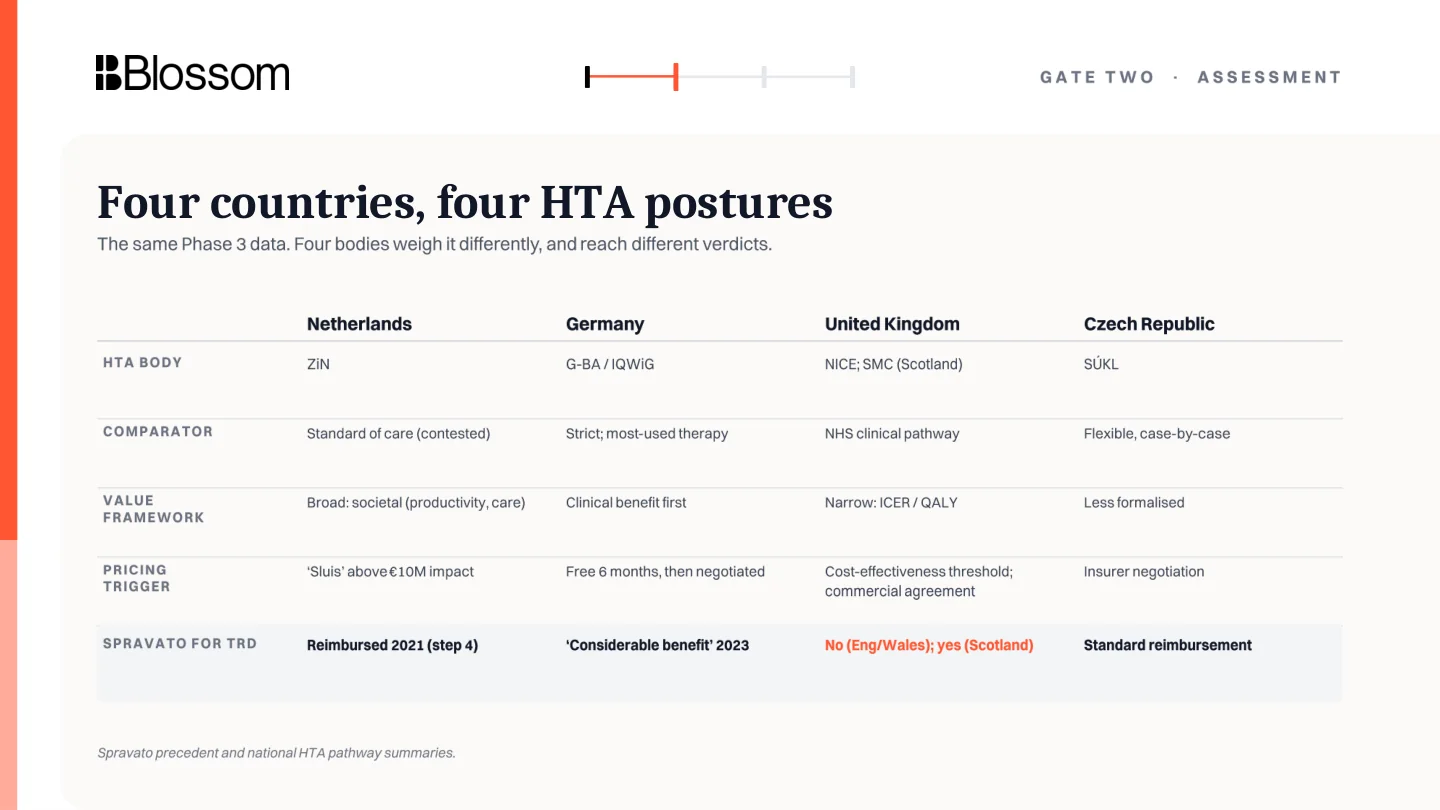
The same phase 3 data can look different in 4 HTA systems. The Netherlands, Germany, the United Kingdom, and Czech Republic each ask a different value question.

The Netherlands can take a broader societal view. Germany is more focused on clinical benefit. NICE and SMC place cost-effectiveness and NHS pathways at the centre. Czech reimbursement is more flexible and negotiation-driven.

That means one positive trial package will not create one European answer. The Europe Access Clocks and Spravato precedent resources show how quickly these national postures can diverge.

Related Blossom resources

Gate three · Payment

Who actually pays for what

Slide 13
Payment gate after approval and assessment have cleared.

Slide transcript

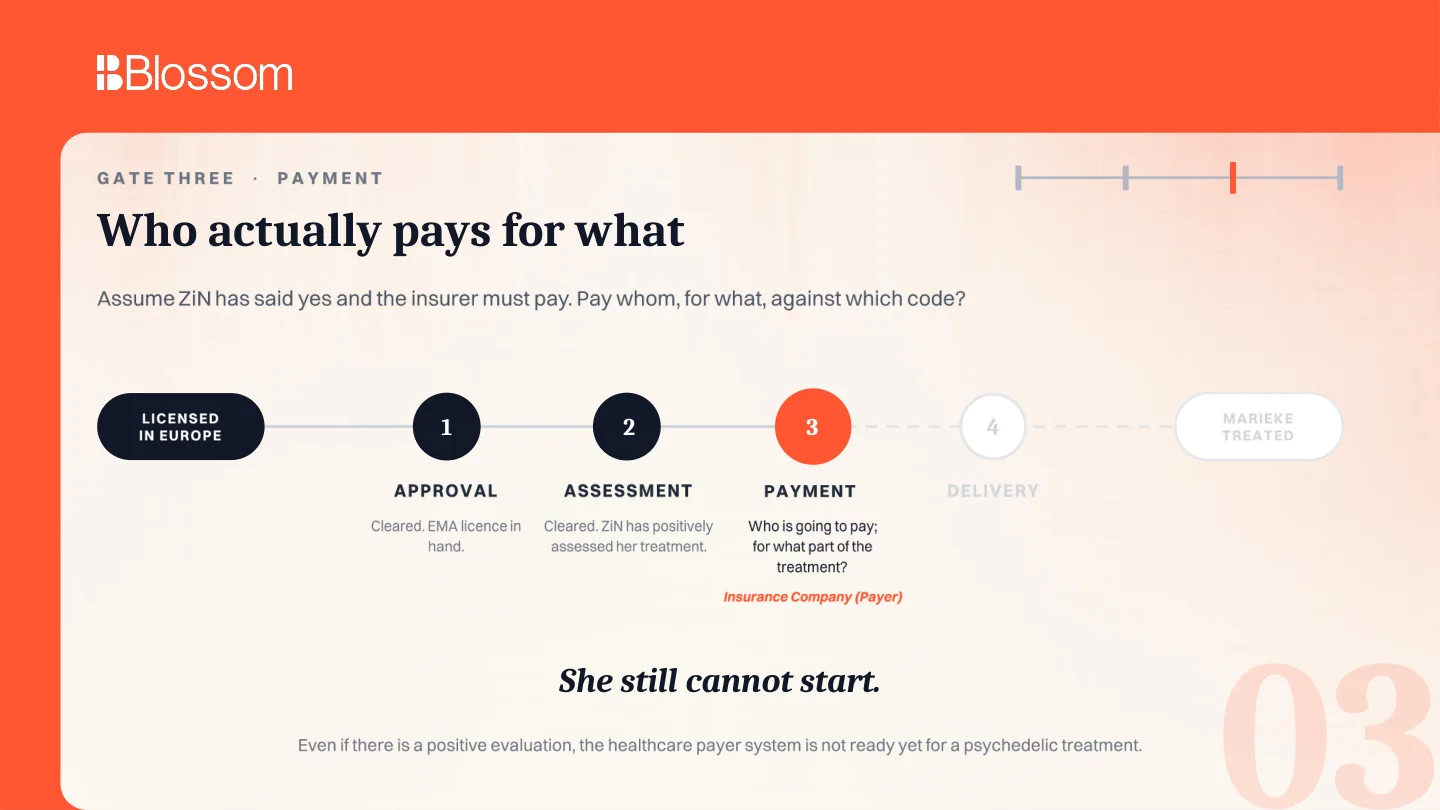
Now assume the assessment gate clears. ZiN says yes, and the insurer has to pay. Marieke can still get stuck.

The payment question is: pay whom, for what, and against which code? Psychedelic therapy is not only a medicine. It is screening, preparation, dosing, monitoring, integration, follow-up, rooms, staff time, and governance.

That is why the psychedelic therapy payment bundle matters. Without a defined payment object, a positive HTA decision can still leave providers unable to deliver the treatment sustainably.

Related Blossom resources

Gate three · Payment

No clean payment route

Slide 14
Payment-route mismatch across screening, preparation, dosing, integration, and follow-up.

Slide transcript

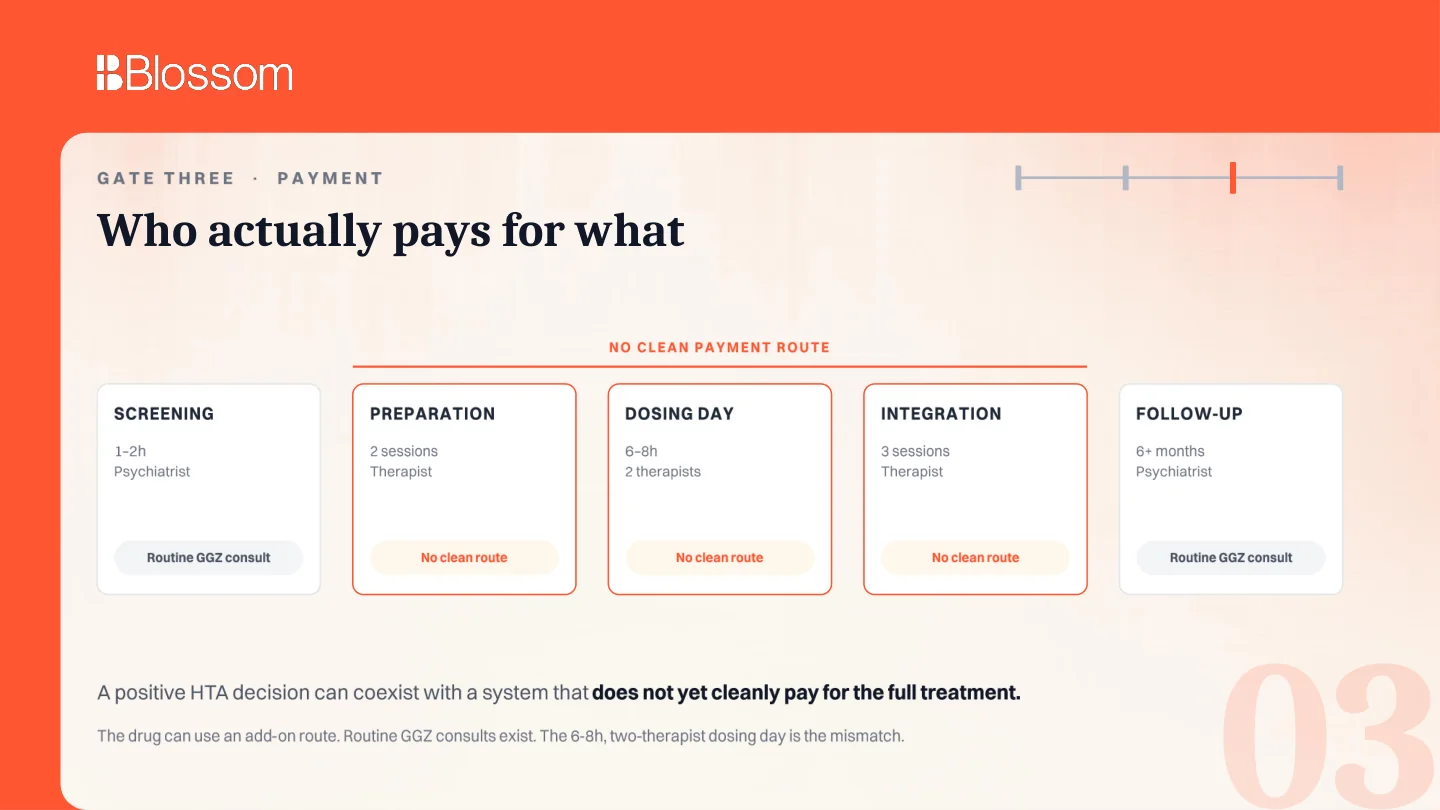
In Dutch mental healthcare, some pieces already have a route. Screening and follow-up can look like routine GGZ consultations. The drug itself can use a medicine route.

The hard parts are preparation, dosing day, integration, and the way those pieces fit together. A 6-to-8-hour dosing day with 2 therapists is not a normal billable unit.

So the question is not only whether the medicine is reimbursed. The question is whether the full clinical delivery model has a payment route that clinics can actually use.

Related Blossom resources

Gate three · Payment

Three payment options to explore before approval

Slide 15
Three payment options: performance-linked pricing, episode payment, and managed access.

Slide transcript

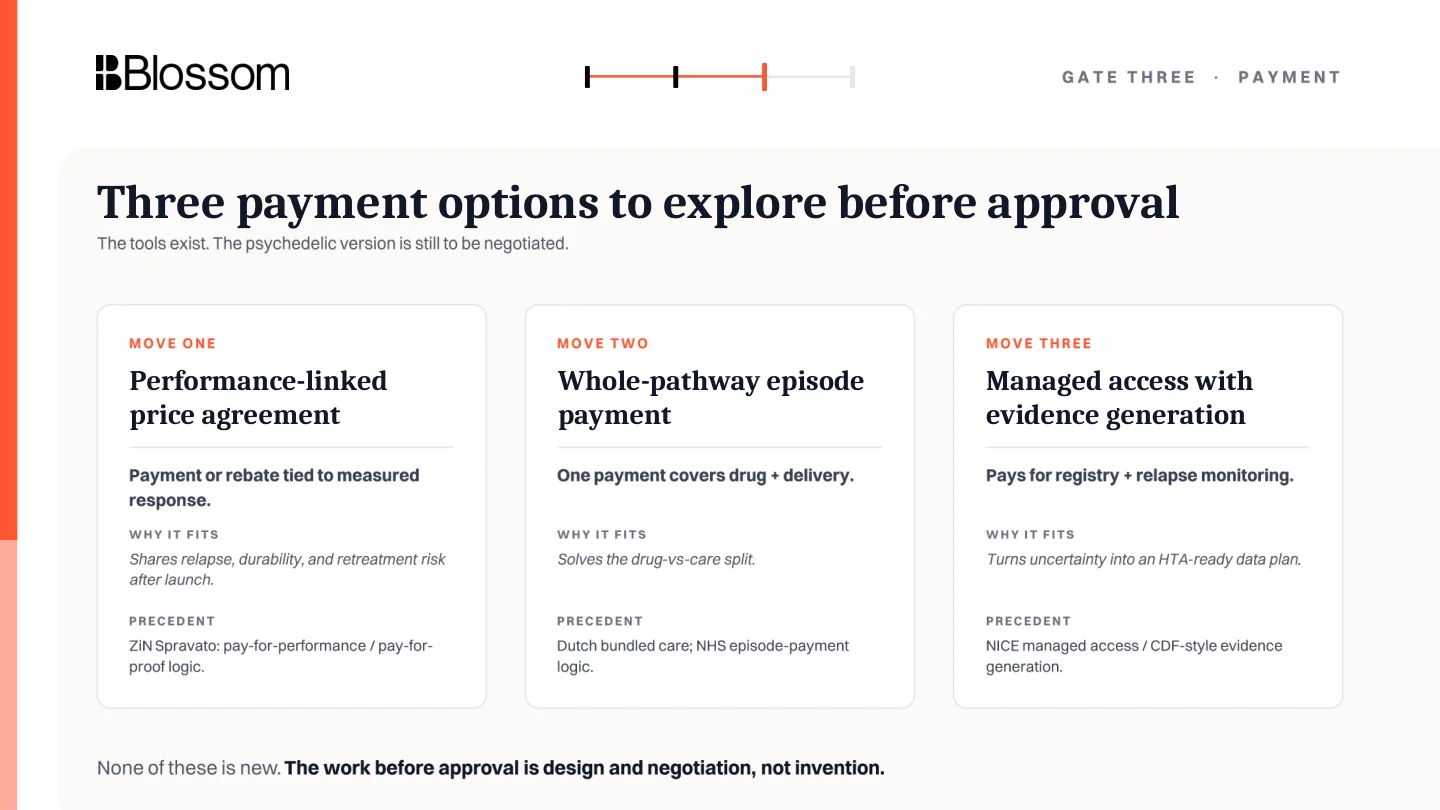
There are at least 3 payment moves to explore before approval. None is new. The work is design and negotiation, not invention.

The first is a performance-linked price agreement, where payment or rebate is tied to measured response. That can share relapse, durability, and retreatment risk after launch.

The second is a whole-pathway episode payment: one payment for the drug plus delivery. That is the logic behind the payment bundle.

The third is managed access with evidence generation, where the registry and follow-up work are part of the access deal. That connects directly to real-world evidence and registry design.

Related Blossom resources

Gate three · Payment

Four countries, four billing realities

Slide 16
Country comparison of payment architectures and billing realities.

Slide transcript

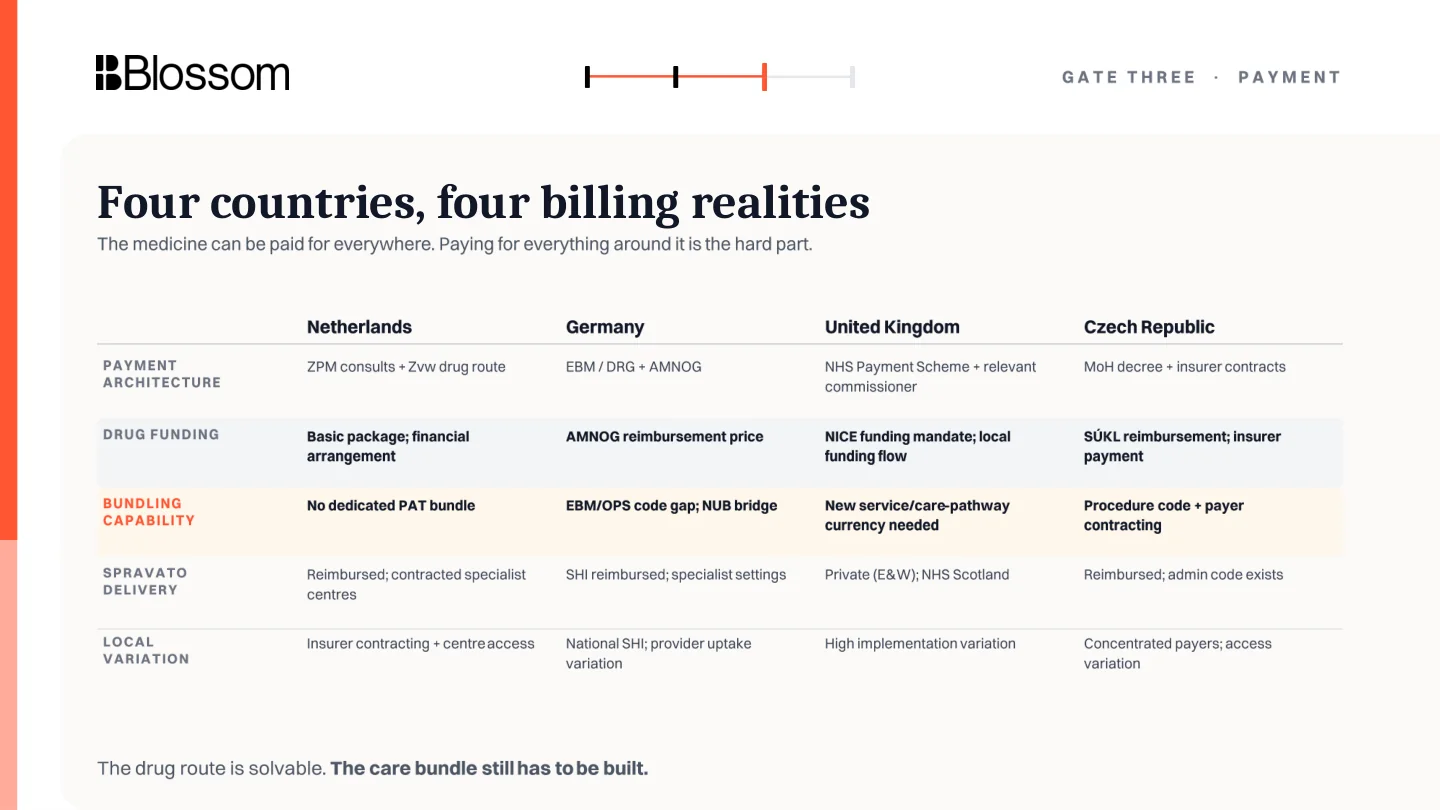
Across countries, the drug route is usually more solvable than the care route. The Netherlands, Germany, the United Kingdom, and Czech Republic all have ways to pay for medicines.

What they do not yet have is a clean psychedelic-assisted therapy bundle that covers the surrounding care in a way providers can use.

That is the billing reality to solve: not just reimbursement price, but codes, contracts, service currencies, and provider uptake. The payment bundle is where those pieces have to come together.

Related Blossom resources

Gate four · Delivery

Marieke needs somewhere to go

Slide 17
Delivery gate showing the need for clinic, workforce, and referral path.

Slide transcript

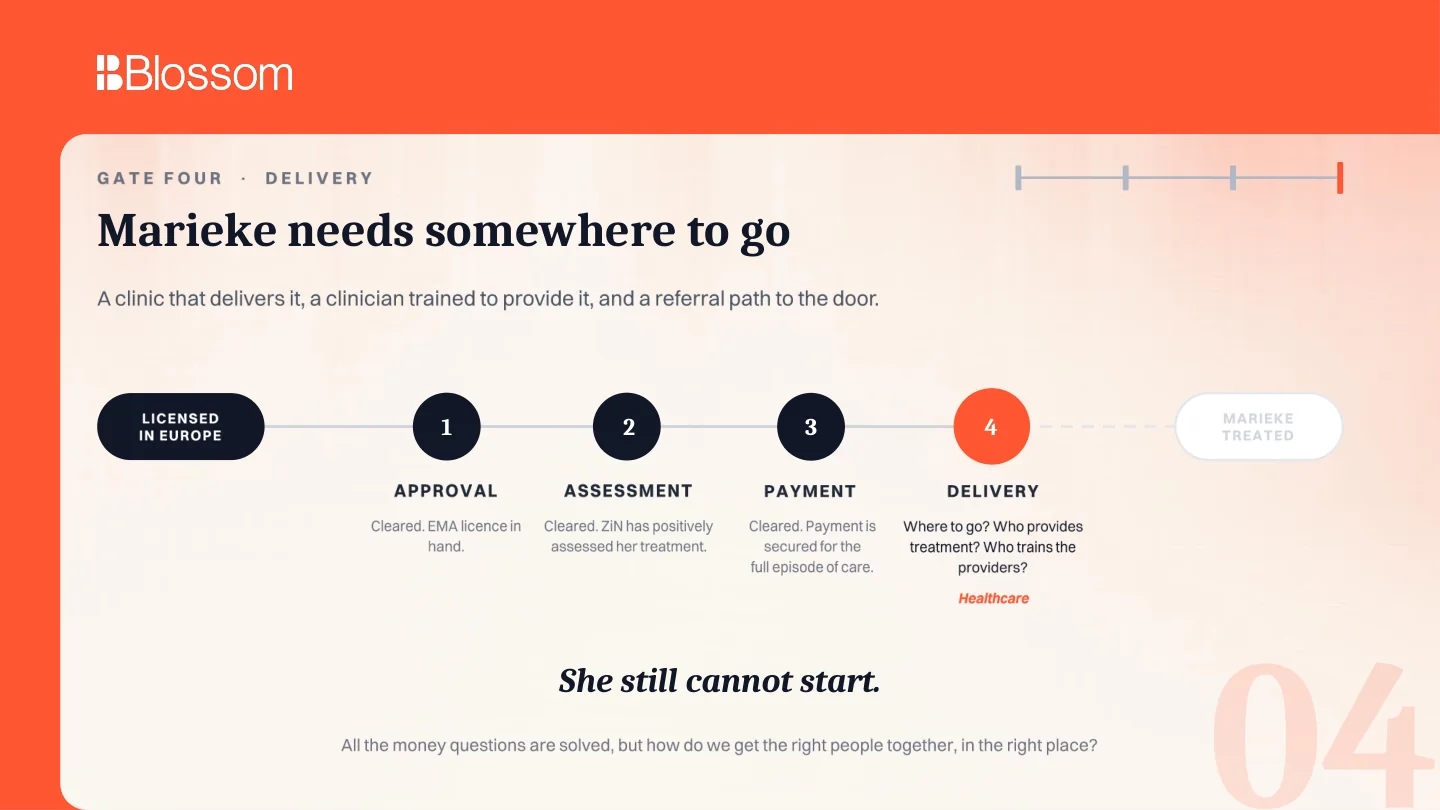
Even if approval, assessment, and payment all clear, Marieke still needs somewhere to go.

Delivery means a clinic, trained clinicians, referral rules, screening, escalation, documentation, and follow-up. The clinical delivery model has to be operational, not only described in a protocol.

This is also where patient navigation matters. A reimbursement decision does not automatically create a safe referral, screening, and triage pathway.

Related Blossom resources

Gate four · Delivery

Dutch launch geography

Slide 18
Map of possible Dutch psychedelic-assisted therapy access sites.

Slide transcript

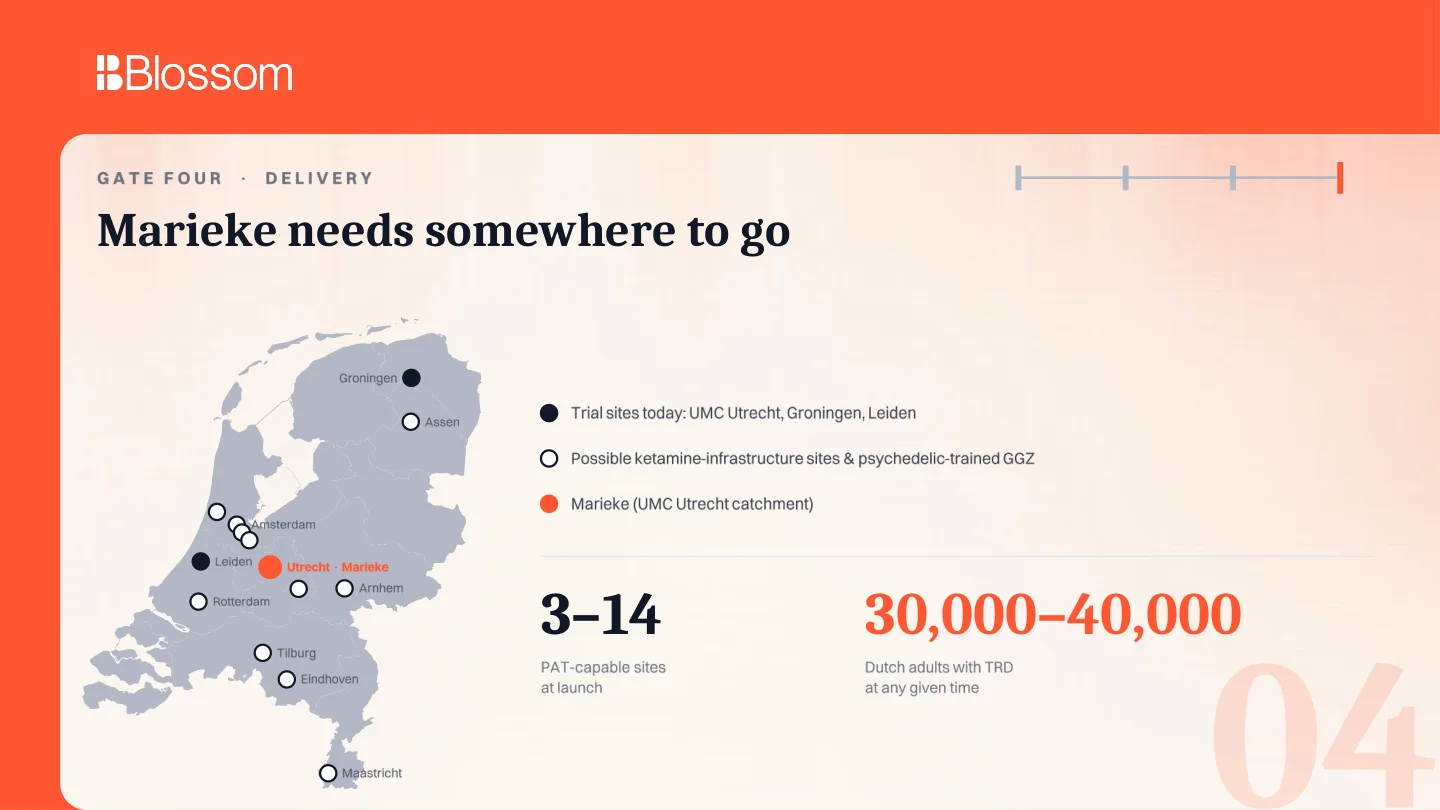
In the Netherlands, the likely launch geography is narrow. Trial sites today include Utrecht, Groningen, and Leiden, with possible capacity around ketamine infrastructure and psychedelic-trained GGZ teams.

For Marieke, who lives near Utrecht, that geography matters. A site on a map is not the same as reachable care. Blossom's Netherlands Psilocybin Access Sites resource tracks this launch-site question.

The working estimate is 3 to 14 PAT-capable sites at launch, against roughly 30,000 to 40,000 Dutch adults with treatment-resistant depression at any given time.

Related Blossom resources

Gate four · Delivery

Capacity is the binding constraint

Slide 19
Scenario model for clinically deployable psychedelic-assisted therapy capacity in the Netherlands.

Slide transcript

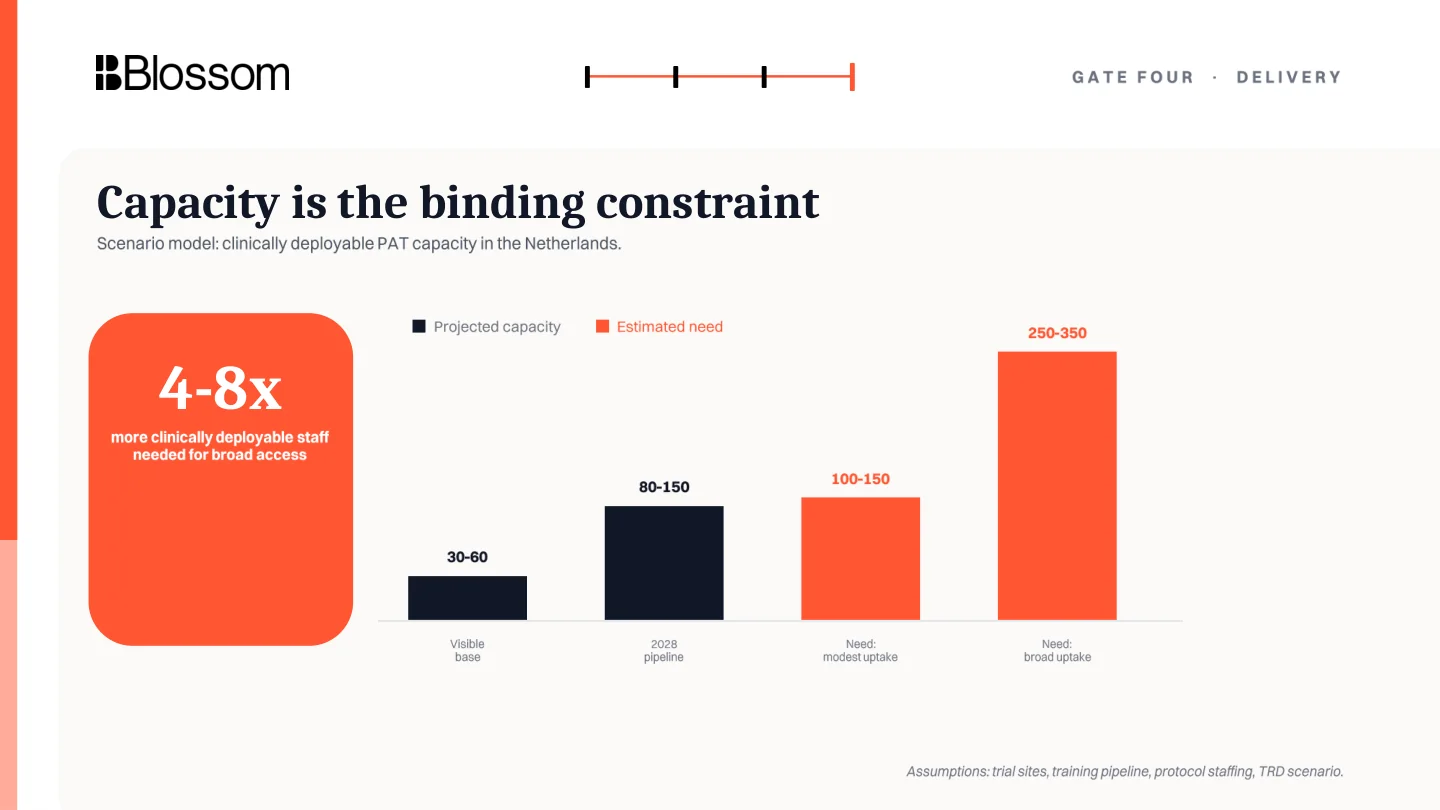
Capacity is likely to be the binding constraint. The visible Dutch base may be 30 to 60 active clinicians, with perhaps 80 to 150 by 2028 depending on the training pipeline.

Even a modest uptake scenario could require 100 to 150 clinically deployable staff. Broad access could require 250 to 350. That is 4 to 8 times more than the visible base.

The point of the Netherlands Psychedelic Therapy Workforce model is not to pretend the numbers are exact. It is to show that workforce is not a side issue; it can decide whether access exists.

Related Blossom resources

Gate four · Delivery

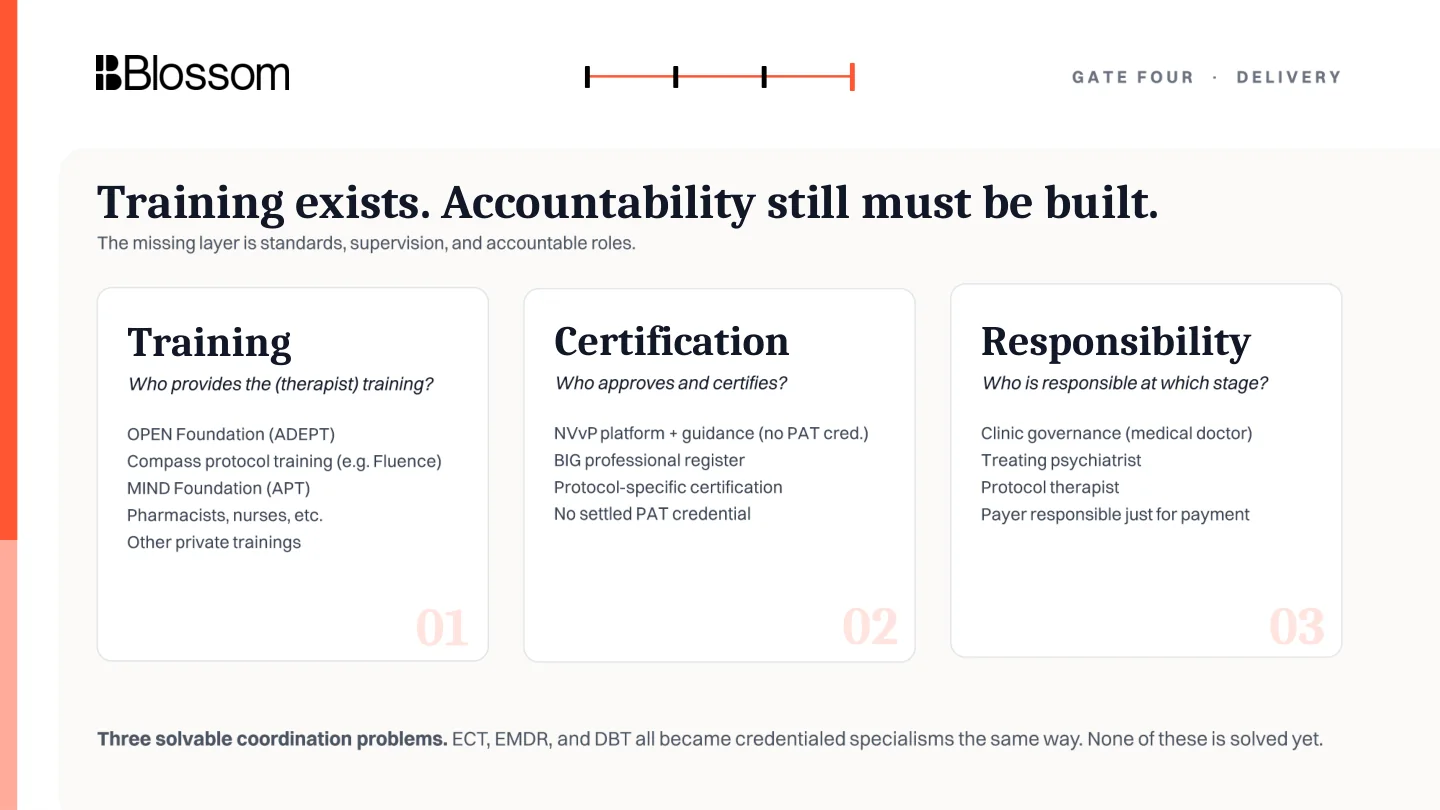
Training exists. Accountability still must be built.

Slide 20
Training, certification, and responsibility coordination problems.

Slide transcript

Training exists, but accountability still has to be built. The missing layer is standards, supervision, certification, and clear responsibility.

There are credible training signals from groups such as the OPEN Foundation, MIND Foundation, and protocol-specific providers. But training alone is not the same as a national clinical credential.

The practical questions are: who trains, who certifies, and who is responsible at each stage of care? The training and credentialing resource frames those layers.

Related Blossom resources

Gate four · Delivery

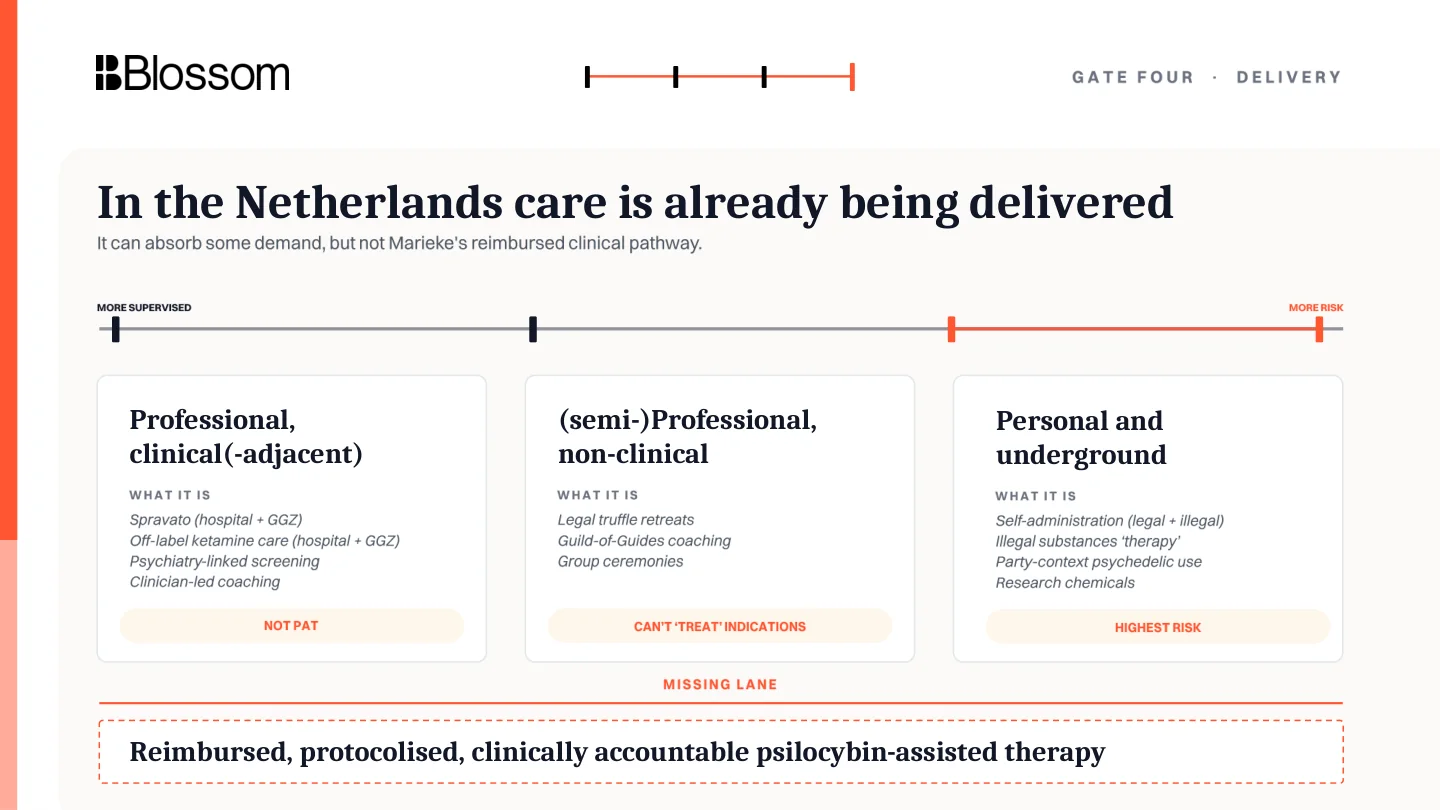
In the Netherlands care is already being delivered

Slide 21
Risk and professionalism lanes for current psychedelic care in the Netherlands.

Slide transcript

In the Netherlands, psychedelic care is already happening in several lanes. Some is clinical or clinical-adjacent, such as Spravato or off-label ketamine care. Some is non-clinical, such as legal truffle retreats or coaching. Some is personal, underground, or higher risk.

Those lanes may absorb some demand, but they are not Marieke's reimbursed clinical pathway. The missing lane is protocolised, accountable psilocybin-assisted therapy within healthcare.

That distinction is why Blossom separates clinical care and retreat pathways instead of treating all psychedelic access as one category.

Related Blossom resources

Gate four · Delivery

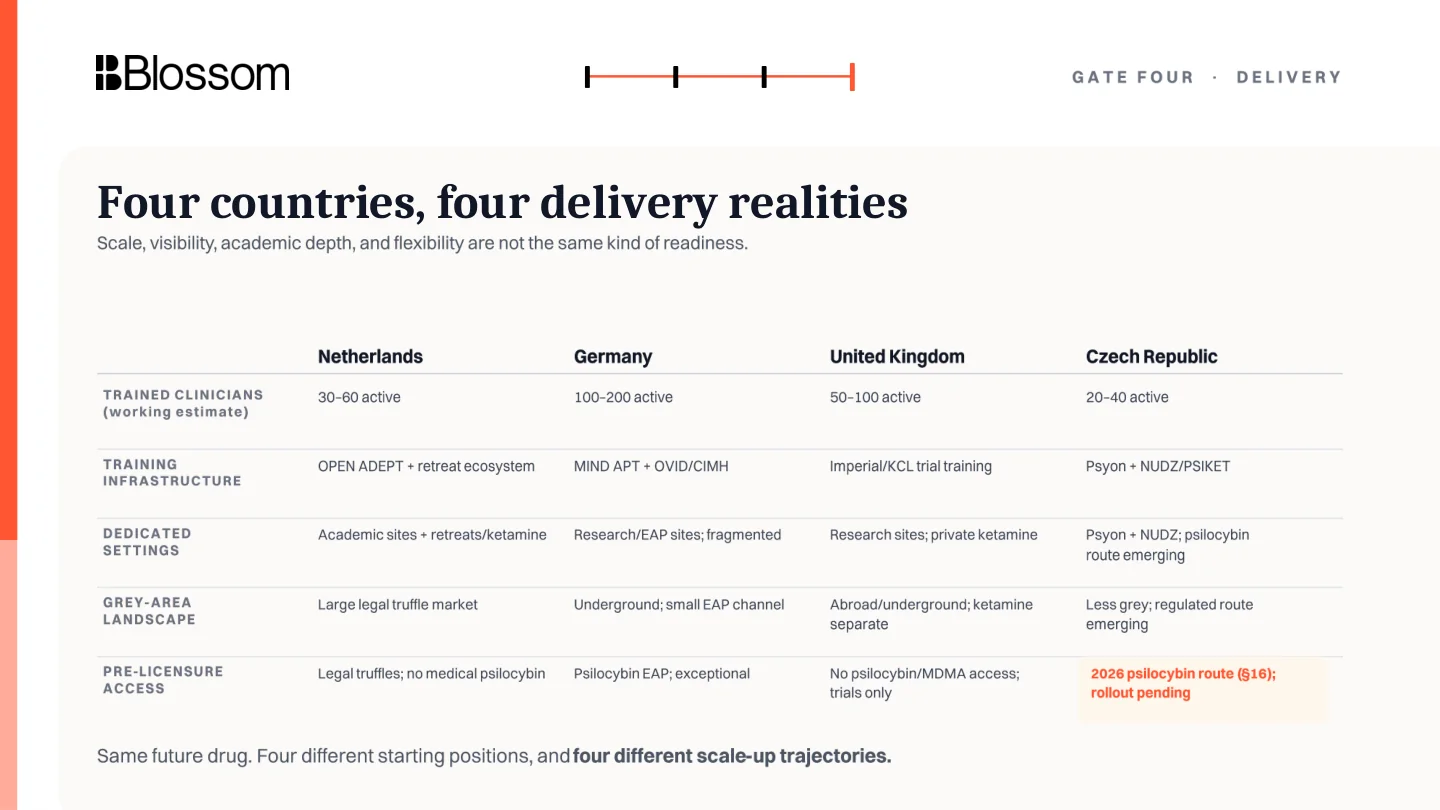
Four countries, four delivery realities

Slide 22
Country comparison of delivery readiness and training infrastructure.

Slide transcript

The same future medicine will land in 4 very different delivery environments. Scale, visibility, academic depth, and flexibility are not the same kind of readiness.

The Netherlands has legal truffles and visible adjacent practice, but no reimbursed medical psilocybin pathway. Germany has deeper research and EAP signals, but a fragmented delivery base. The UK has strong research sites but limited pre-licensure access. Czech Republic has an emerging regulated psilocybin route.

Those starting positions shape the scale-up path. The Europe Access Clocks show the formal timing problem; delivery readiness shows the practical one.

Related Blossom resources

Part three · The agenda

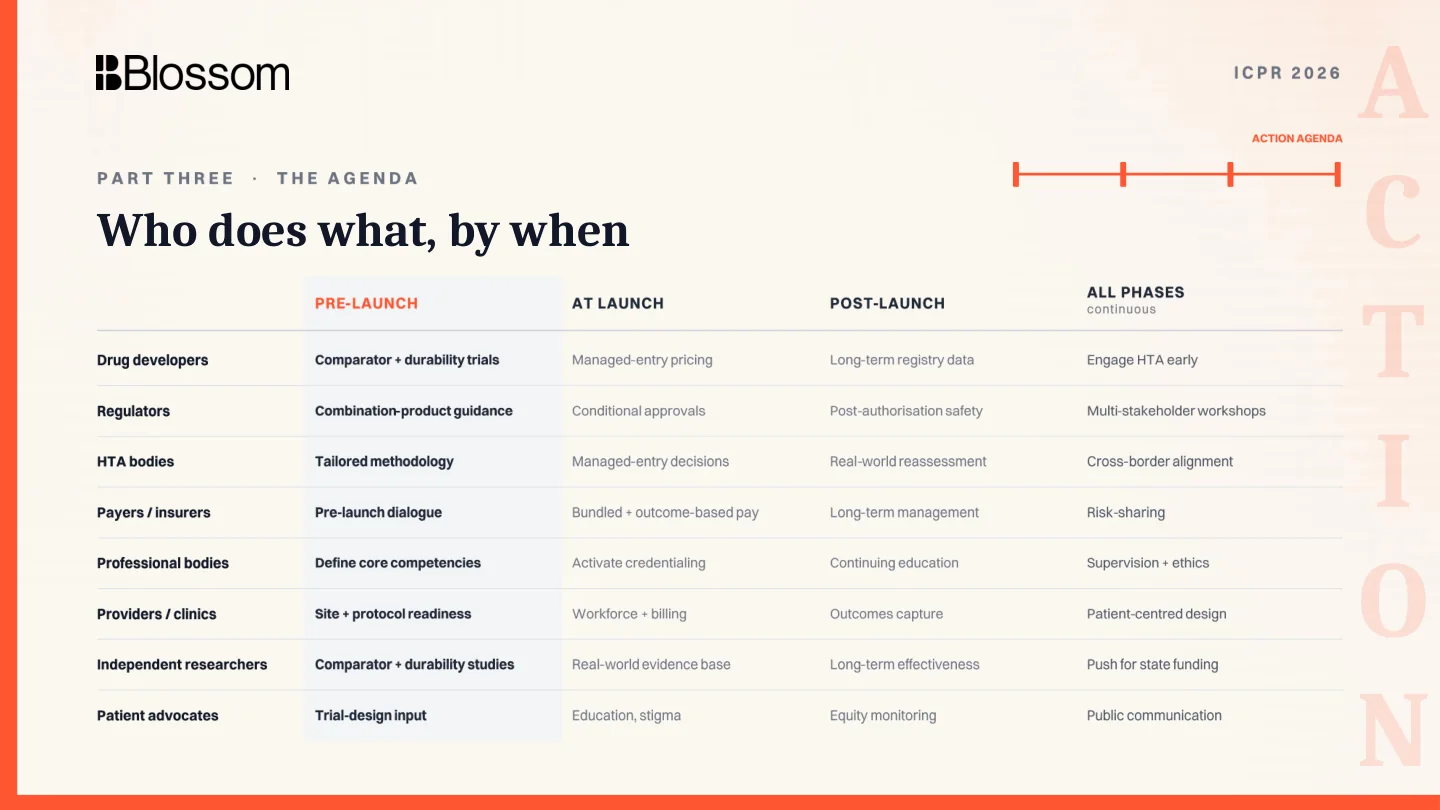
Who does what, by when

Slide 23
Action agenda matrix by stakeholder and phase.

Slide transcript

The agenda is not owned by one actor. Drug developers, regulators, HTA bodies, payers, professional bodies, providers, researchers, and patient advocates all have work to do.

Before launch, the field needs comparator and durability evidence, early HTA engagement, core competencies, site readiness, and patient-centred design. At launch, it needs managed-entry pricing, bundled payment, credentialing, and operational pathways.

After launch, the work becomes long-term evidence, reassessment, supervision, equity monitoring, and public communication. The launch-readiness checklist turns that broad agenda into a more usable sequence.

Related Blossom resources

Action agenda

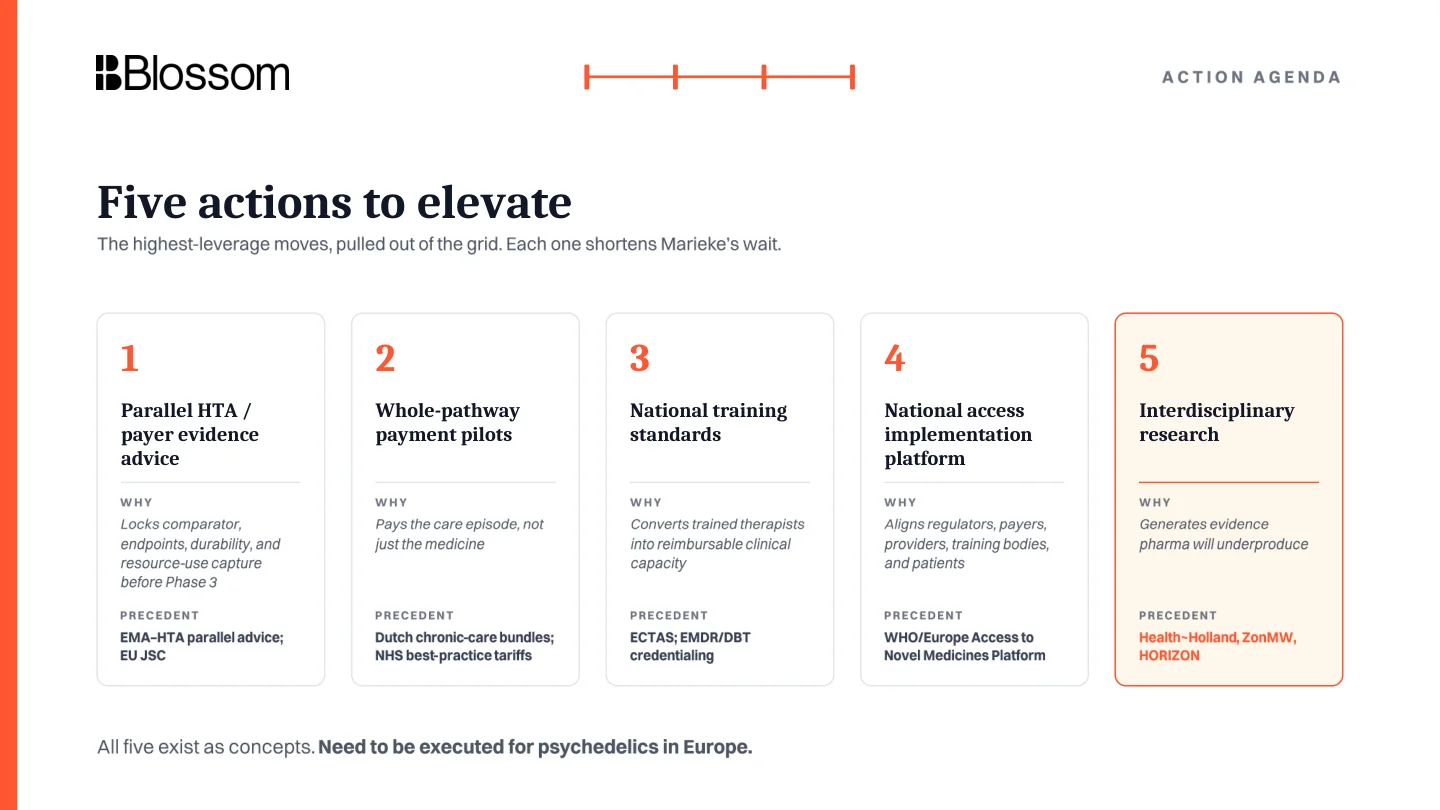
Five actions to elevate

Slide 24
Five high-leverage actions for psychedelic therapy implementation.

Slide transcript

There are 5 high-leverage moves to elevate. First, parallel HTA and payer evidence advice, so comparator, endpoints, durability, and resource-use capture are not left too late.

Second, whole-pathway payment pilots, because the care episode has to be paid for, not just the medicine. Third, national training standards, because trained therapists need to become reimbursable clinical capacity.

Fourth, a national access implementation platform that aligns regulators, payers, providers, training bodies, and patients. Fifth, interdisciplinary research that generates the evidence pharma is unlikely to produce on its own.

All 5 ideas already exist in other parts of healthcare. The question is whether Europe executes them for psychedelic therapies in time. The launch-readiness checklist is the practical version of this agenda.

Related Blossom resources

Action agenda

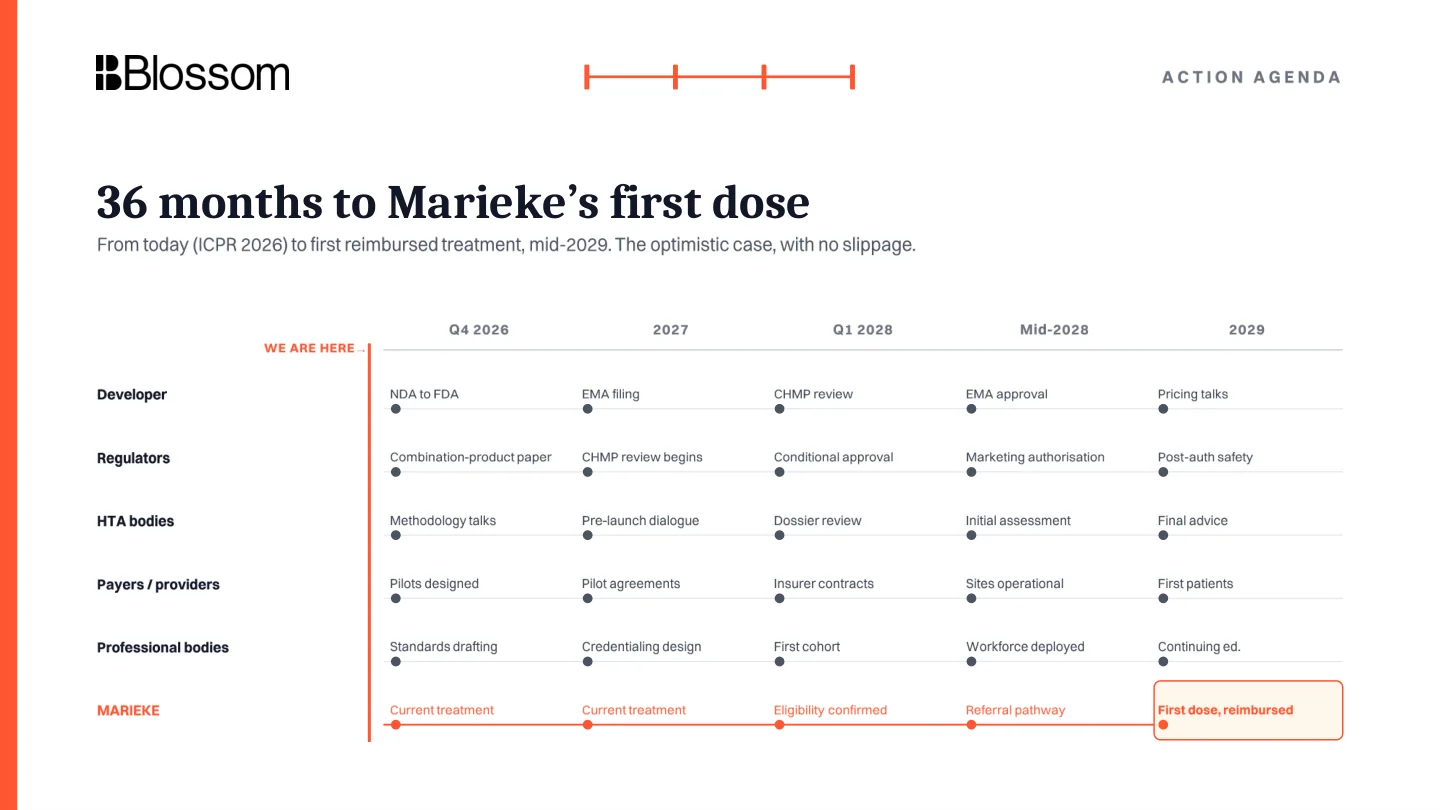
36 months to Marieke’s first dose

Slide 25
Timeline from ICPR 2026 to first reimbursed treatment in 2029.

Slide transcript

This is the optimistic 36-month version: from ICPR 2026 to Marieke's first reimbursed treatment around mid-2029, with no major slippage.

Developers would move through FDA and EMA filing, CHMP review, EMA approval, and pricing talks. Regulators would clarify combination-product questions and post-authorisation safety. HTA bodies would move from methodology talks to dossier review and final advice.

At the same time, payers and providers would design pilots, agree contracts, and open sites. Professional bodies would move from standards drafting to credentialing and workforce deployment. That parallel work is what turns approval into access.

The timeline is ambitious, which is why launch readiness and real-world evidence have to begin before the product is approved.

Related Blossom resources

Marieke at 50

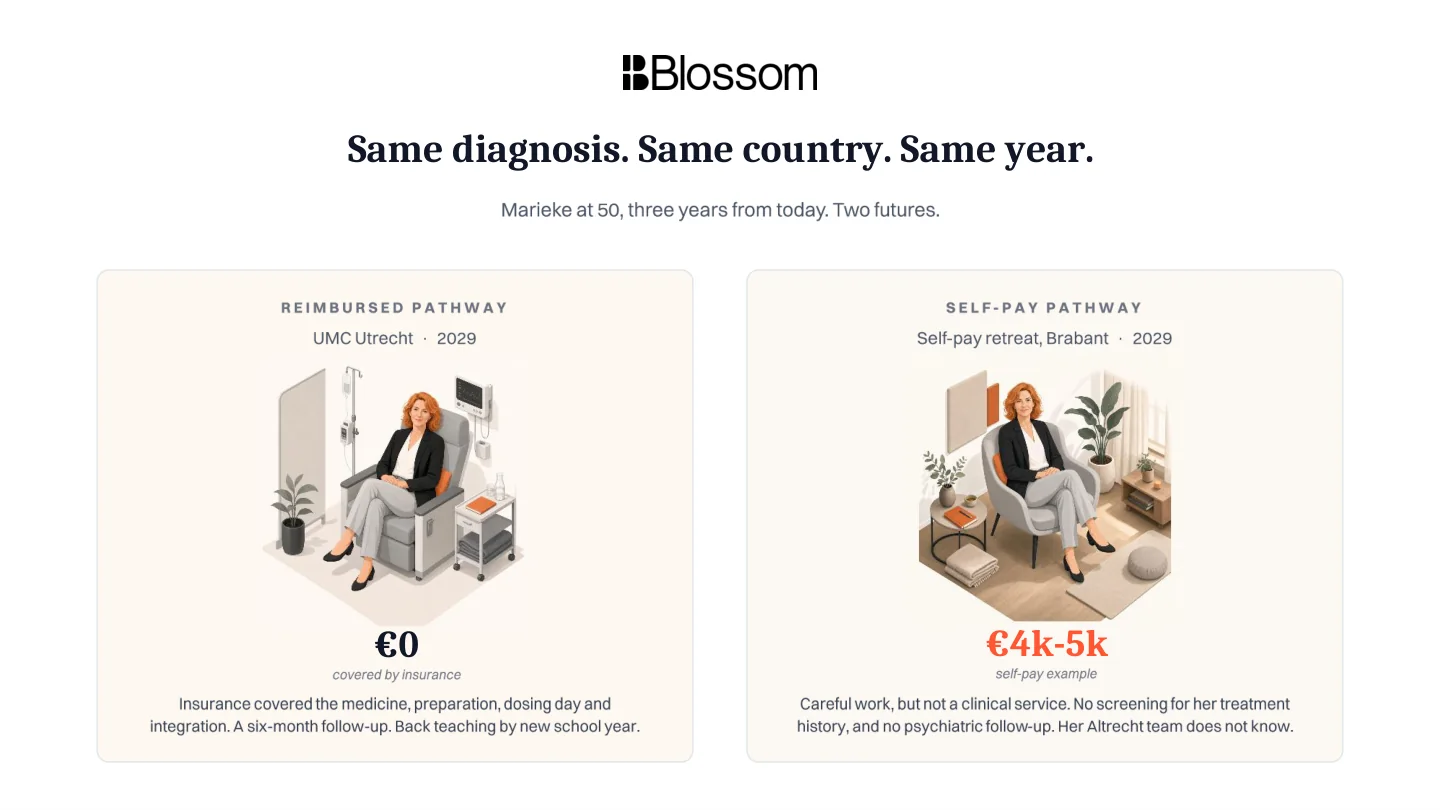
Two futures

Slide 26
Comparison of reimbursed pathway and self-pay pathway futures.

Slide transcript

Three years from now, Marieke could face 2 very different futures.

In the reimbursed pathway, she is treated through a clinical site, with the medicine, preparation, dosing day, integration, and follow-up covered by insurance. Her existing care team knows what happened, and there is accountability around the treatment.

In the self-pay pathway, she may still receive careful support, but it is not the same as a clinical service. There may be no psychiatric screening for her treatment history, no shared follow-up, and no link back to Altrecht.

Same country, same diagnosis, same year. The difference is whether the system built a clinical access pathway. That is the core distinction in Clinical Care vs Retreat Pathways.

Related Blossom resources

Closing

Approval does not equal access

Slide 27
Closing slide with report and Road to Access links.

Slide transcript

Approval does not equal access. The next 3 years decide which Europe Marieke gets.

This work builds on the reimbursement report by Floris Wolswijk and Martin Gisby, funded by Norrsken Mind. The full report is available at psychedelicsandreimbursement.com.

For the broader implementation library, continue with Blossom's Road to Access. That is where the evidence, reimbursement, payment, delivery, and equity questions sit together.

Related Blossom resources